
What Would a Data Scientist Do With Your Hotel's Booking Data?

An introduction - and why I think hospitality is sitting on an untapped goldmine - and what becomes possible when it's finally put to work.

Introduction

My name is Max Lepone. I recently graduated with a First-Class Honours degree in Computer Science and Mathematics from Nottingham Trent University, where I was also awarded the Outstanding Dissertation Prize for my research into Topological Data Analysis - a mathematical method for finding hidden patterns in complex, changing systems. I now work as an AI Software Engineer at Marhala AI, where we build intelligent tools for the hospitality and travel industry.

The combination of a deep technical background and meeting one of the most data-rich industries in the world is what prompted me to write this post.

Because here is what strikes me every time I look at how hotel and travel agencies operate: the data is there. Booking histories, cancellation patterns, seasonal demand curves, guest preferences, length-of-stay distributions, channel performance. Most mid-to-large hospitality businesses are sitting on years of it. And yet, in conversation after conversation, the decisions being made - on pricing, on staffing, on which guests to retarget, on when to run promotions - are still driven largely by instinct and spreadsheets.

I want to explore what changes when you start treating that data seriously.

The difference between having data and using it

Let me start with the distinction that matters.

Collecting data and analysing data are not the same thing. Most hotels collect data. Booking systems log every reservation. Customer Relationship Management (CRM) platforms track guest history. Revenue management tools pull in occupancy rates. But collection is passive - it just means the information exists somewhere. Analysis is active: it means asking a specific question of the data, choosing the right method to answer it, and being honest about what the answer does and doesn't tell you.

In machine learning - the branch of AI that learns patterns from historical data to make predictions - the quality of the analysis at the start determines the ceiling of everything that follows. A model trained on poorly understood data will make poor predictions, no matter how sophisticated the algorithm. This is something I encountered repeatedly during my degree, and it is just as true in a hotel revenue management context as in academic research.

The question worth asking isn't "do we have data?", as almost every hotel does. The question is "are we asking the right questions of it, and are we equipped to answer them honestly?"

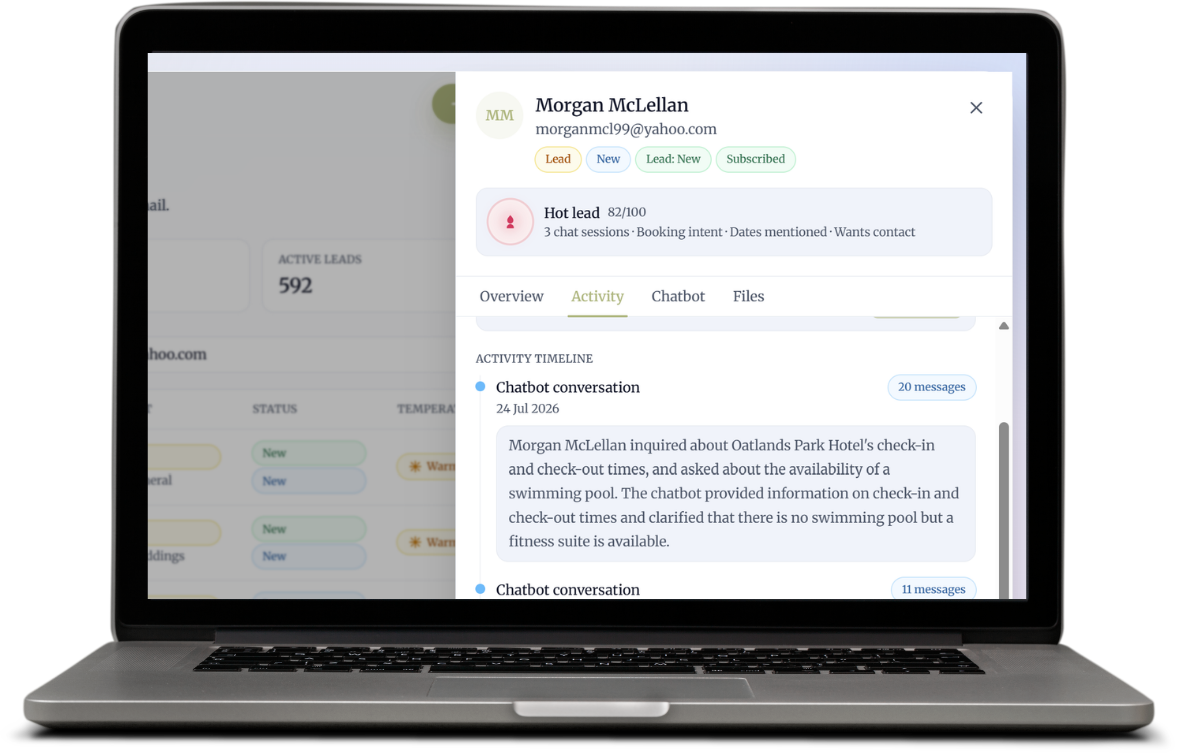
CRM customer profiling illustration for hotel guest segmentation

Three questions your booking data can answer

To make this concrete, here are three areas where rigorous data analysis - the kind that goes beyond a pivot table - tends to unlock the most value for hotels and travel businesses.

So, What Would a Data Scientist Actually Do?

A common misconception is that a data scientist simply builds an AI model and waits for insights to appear. In reality, the first step is understanding the business problem before writing a single line of code. If a hotel wants to reduce cancellations, increase direct bookings or improve occupancy during quieter periods, a data scientist begins by exploring the booking data to understand how guests behave. This involves cleaning incomplete records, identifying unusual patterns, measuring seasonal trends, and testing whether factors such as booking channel, lead time, room type or guest nationality genuinely influence commercial outcomes. Much of the value comes long before any artificial intelligence is introduced.

Once the data has been prepared, different analytical and machine learning techniques can be applied depending on the question being asked. Predictive classification models can estimate the likelihood of a future cancellation, while clustering algorithms can group guests into meaningful segments based on their booking behaviour rather than assumptions. Time-series forecasting models help predict future occupancy and demand across seasons, enabling more informed staffing and pricing decisions. Recommendation models can identify which offers or packages are most likely to appeal to different guest segments, while anomaly detection techniques can highlight unusual booking activity that may indicate fraud, unexpected market shifts or operational issues. Rather than replacing the expertise of hotel managers, these models provide evidence that supports faster and more informed commercial decisions.

1. Who is likely to cancel - and when?

Cancellation forecasting is one of the clearest applications of predictive modelling (a technique where historical patterns are used to estimate the probability of a future event) in hospitality. Most hotels treat cancellations as a revenue problem to be managed reactively - through overbooking policies or last-minute promotions. A well-built model can shift that to proactive: flagging specific bookings with a high cancellation probability days or weeks in advance, so the revenue or sales team can intervene with a targeted retention offer rather than waiting for the gap to appear.

The inputs that tend to matter most aren't always the obvious ones. Lead time, booking channel, room type, length of stay, and whether a guest has cancelled before, are all strong signals. The patterns are in your historical data already. The question is whether anyone is looking for them.

In practice, this is often approached as a classification problem using machine learning models such as Logistic Regression, Random Forests or Gradient Boosted Trees, which learn from historical booking behaviour to estimate the probability that a reservation will be cancelled.

2. Are you targeting the right guests?

Every guest is different: some become loyal, high-value customers over time, while others may only visit once. Segmentation (dividing your guest base into groups with meaningfully different behaviours or needs) is one of the most powerful things a data-driven approach can do for a hotel's commercial team.

Done well, it tells you which guests respond to loyalty incentives, and which ones will book regardless, which segments drive ancillary revenue, which arrive and leave without engaging further, and which channel produces guests who actually come back, versus those who were just price-shopping. These distinctions matter enormously for where you allocate your marketing budget - but they are invisible unless you have both the data and the analytical framework to surface them.

To identify these groups objectively, data scientists commonly use clustering techniques such as K-Means or Hierarchical Clustering, allowing guest segments to emerge naturally from booking behaviour rather than relying on manually defined categories.

3. Are your pricing decisions leaving money on the table?

Dynamic pricing (adjusting rates in real time based on demand, competitor pricing and other signals) is well-established in the airline industry and increasingly common in hotels. However, there is a meaningful gap between having a revenue management system that applies basic rules and having a genuinely data-driven pricing strategy that learns from outcomes over time.

The latter requires understanding not just what your competitors are charging today, but how your own historical demand responds to price changes at different lead times, in different seasons, for different room types. That is a machine learning problem - and it is one where even relatively modest improvements in accuracy tend to translate into material revenue gains.

Demand forecasting is typically performed using time-series models such as Prophet or LSTM neural networks, enabling hotels to anticipate occupancy patterns and optimise pricing strategies well in advance.

Ultimately, what a data scientist brings is not simply AI, but a structured approach to turning years of booking records into measurable commercial decisions. The value lies not in collecting more data, but in extracting the patterns that already exist and using them to improve how a hotel operates.

Why now?

The reason I am writing this now, and the reason I joined Marhala AI, is that the tools to do all of the above have become dramatically more accessible over the past few years. The barriers that once made sophisticated data analysis the preserve of large chains with dedicated analytics teams are coming down. The methods exist. The computation is affordable. What is still scarce is the combination of technical fluency and genuine understanding of how hospitality businesses actually operate day-to-day.

That is the gap I am interested in. Not AI for its own sake - but AI applied carefully, to specific commercial problems, in a way that a GM or Sales Director can understand and act on.

What we're building at Marhala AI

At Marhala AI, we're bringing these capabilities together into a single platform designed specifically for hotels. Rather than relying on multiple disconnected systems, our goal is to provide one dashboard that helps hotels manage guest relationships, drive direct bookings, automate marketing, and make better commercial decisions using data and AI.

The Marhala AI platform brings together:

  1. CRM - Capture guest information, manage customer relationships, and communicate with guests directly from a central dashboard.
  2. Lead Generation Dashboard - Capture booking intent, record key customer data points, and automatically score leads as cold, warm, or hot to help teams prioritise follow-up.
  3. Room Booking Engine - Enable guests to book directly, reducing reliance on third-party booking channels.
  4. Gift Voucher Shop - Generate additional revenue through online gift voucher sales.
  5. AI Customer Chatbot - Add an intelligent chatbot to any website to answer enquiries, capture leads and assist guests around the clock.
  6. Bespoke Website Design - Create high-performing, conversion-focused hotel websites tailored to each property's brand.
  7. TV Web Applications - Display live offers, announcements, events and other custom content on TV screens throughout hotels or reception areas.
  8. AI-Assisted Social Media - Generate content suggestions and publish posts directly to Facebook and Instagram from within the Marhala AI platform.
  9. Industry Insights - Monitor competitor activity, track market trends and stay informed with the latest hospitality news.
  10. AI-Powered Email Marketing - Create and send bulk email campaigns with AI-generated content to engage past and prospective guests.

Your business can pick and choose the features you want, depending on where you're at.

Whether you're at reception, in sales, marketing or management, you'll only see the features and information that are relevant to your role. Compliant with data protection law and commercial confidentiality.

This integrated approach reduces the need for multiple software subscriptions, eliminates data silos, and gives hotel teams a single source of truth for managing guests, marketing activities, bookings and commercial performance.

A conversation, not a lecture

This is the first in what I intend to be a series of posts exploring how data science and AI can create practical values for hotels and travel businesses - written for people who are data-obsessed but didn't necessarily train as data scientists.

If any of the questions above resonate with challenges you are working through, or if you have a view on where you think the biggest opportunities lie in your business, I would genuinely like to hear from you. The most useful thing I can do at this stage of my career is listen to the problems before suggesting the solutions.

Feel free to connect or you can email me on [email protected]

Request a tailored Marhala AI demo for your hospitality or travel business.

Tell us who you are and we will follow up with a conversation around your guest journey, current systems and the best next stage for your digital experience.

Company

Marhala AI Ltd (17161138), registered in London, United Kingdom

Registered office

128 City Road, London, United Kingdom, EC1V 2NX

Focus

AI mobile app and software development for hospitality and travel, including WhatsApp, CRM, email automation, website design and mobile apps.